ScottGu just made available a free downloadable eBook in PDF format as well as a simple and easy-to-understand sample project called Nerddinner. This eBook is actually a chapter from his upcoming book on MVC, but it is an end-to-end tutorial that walks through building a small but complete ASP.NET MVC application from scratch.
This Blog Has A New Home!
Saturday, March 14, 2009
Friday, August 17, 2007
The Castle Project
In the last couple of years I have noticed a steadily growing interest in the .NET community around the Inversion of Control (IoC) and Dependency Injection (DI) patterns. This is partly due to the fact that a number of excellent frameworks have emerged and gained popularity that allow us to use these designs in our applications relatively painlessly. One such framework is the open source Castle Project. In my opinion Castle is the best implementation of IoC and DI among many others that I have come across including Spring.NET, NInject, and ObjectBuilder. This is however my opinion; which framework you use largely depends upon your requirements and your preferences.
If you are just getting started with Castle or are curious about why the heck one should use IoC and DI, I strongly suggest you check out the 3-part article series by Simone Busoli. I just came across these articles and I can't stress enough how well they are written.
Monday, August 28, 2006
ISP: Interface Segregation Principle
Clients should not be forced to depend on methods that they do not use.In other words, this principle states that if a class performs multiple functions that may be used by different client classes, then those functions should be seperated out into different interfaces according to their usage. The idea behind this principle is to confine the aount of rework to only clients that use a certain interface, should the interface of a depended-upon class changes.
WWF 101: Introduction to Windows Workflow Foundation
Sunday, August 27, 2006
WCF 101: Introduction to Windows Communication Foundation
DIP: Dependency Inversion Principle
Essentially what this principle means is that in a tiered design, higher level modules and lower level modules should not directly depend on each other; instead they should only depend on abstractions. Moreover, abstractions should not have any knowledge of details (other classes in the system). This principle closely relates to some of the other design principles I discussed previously in that it yields a design that is highly decoupled ensuring that minor changes in one part of the application do not cause a domino effect in other parts of the application. Moreover such a design is extensible -- as new business entities are added, usually such as design scales well by requiring only new code to be added rather than existing code to be modified. ASP.NET 2.0's Provider Model is a great example of such a design that provides a default implementation for various sub-systems such as Membership, Personalization, Navigation, etc. but also allows developers to modify the default behavior by extending certain classes.
- High-level modules should not depend on low-level modules. Both should depend on abstractions.
- Abstractions should not depend on details. Details should depend on abstractions.
Wednesday, August 23, 2006
LSP: Liskov Substitution Principle
Let q(x) be a property provable about objects x of type T. Then q(y) should be true for objects y of type S where S is a subtype of T.What it means is that if S is a subtype of T, then a function q(x) must behave in the same manner irrespective of the type of x whether it be S or T. In other words, if a piece of code behaves differently for a subtype than a supertype, then that code violates the LSP (and consequently the OCP). Let's say that we work for a bank and that we have a simple teller application. Currently the teller application works with checking and savings account types. Our bank just entered the mortgage business so we need to modify our teller application to support this new account type. During the short analysis phase we decide that since mortgage account is type of an account (IS-A relationship), we can simply create a new mortgage class deriving from the Account abstract class, override a method and a property, and we should be in business. We add a new class as follows: Everything sounds logical, that is until we come across this code in the teller application: Based on our pre-existing code, the ReceiveMoney() method is making a reasonable assumption that the new balance should be equal to the old balance plus the newly deposited amount. This assumption is, however, violated if we pass an instance of the Mortgage class to this method. This is a clear violation of the LSP.
Monday, August 21, 2006
OCP Open-Closed Principle
Software entities (classes, modules, functions, etc.) should beEssentially, what this means is that software's design should be such that it's behavior can be modified by extending the existing source code rather than modifying it. Consider the following example: Notice that the ReceiveMoney() method of the Bank class has to determine the type of account passed in. Only based on that information it can perform the appropriate business logic. Later if we add another account type then we may need to modify this code in order for it to work properly. The above code is, hence, in violation of the Open-Closed principle. So how can we revise our code to conform to the Open-Closed Principle? Abstraction is the answer. Let's take a look: Notice how we got rid of all conditional logic in the ReceiveMoney() method. Also notice that if we later add a new account type, the ReceiveMoney() method will work without any modifications. The revised version of our code above, hence, conforms to the Open-Closed Principle. Let's now consider what happens to our code if a new business rule is added that requires an e-mail notification to be sent to the account holder whenever a deposit is made. Obviously, we'll have to modify the ReceiveMoney() method to perform that logic. Since we can't account for all possible scenarios, we can never acheive perfect closure. With that in mind, design the simplest software that will do the job, and conform to OCP or other such design principles where you see the need.
open for extension, but closed for modification.
Sunday, August 20, 2006
SRP: Single Responsibility Principle
There should never be more than one reason for a class to change.Essentially SRP enforces the concept of high cohesion that should not only be applied to classes but also internals of a class, such as methods. So why is SRP such an important design principle? It is because a class with multiple responsibilities is more difficult to change and more difficult to reuse (design smells: fragility and immobility). While SRP is quite easy to understand, it's not always logical to implement. Consider the following class:
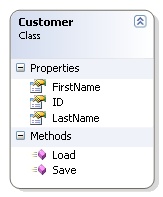
Given the convenience of having a customer class that is smart enough to know how to load and save itself, would you rather break it out like this?:
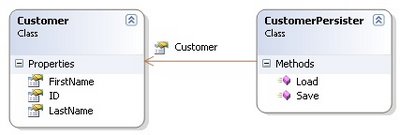
According to SRP, you should, because the combined customer class shares multiple responsibilities: customer business logic, and customer persistence logic. In fact if you use TDD, you may even be forced to separate these two responsibilities.
In practicality, however, while we should keep this principle in mind and try to apply it wherever it makes sense, we should never get so carried away that we start introducing other design smells in our architecture, such as Rigidity, Viscosity, and Needless Complexity.
Saturday, August 19, 2006
Generic Collection<T> and ReadOnlyCollection<T> Are Actually Not Misplaced
Tuesday, July 18, 2006
Inherit With Care
Monday, July 17, 2006
Which UML Models Are The Most Important?
Class models are obviously the most important ones since I can directly generate code from them. Others help me generate artifacts that I feel are essential for project documentation.